The Strategic Power of Brand Language
Brands are no longer just selling products, but also engineering words and phrases that become rooted in our brain, turn customers into walking advertisements, and are able to communicate the brand identity of billion-dollar companies with just a few syllables. From Miu Miu's "Miutine" to "#MyCalvins" - Why Words Matter More Than Ever
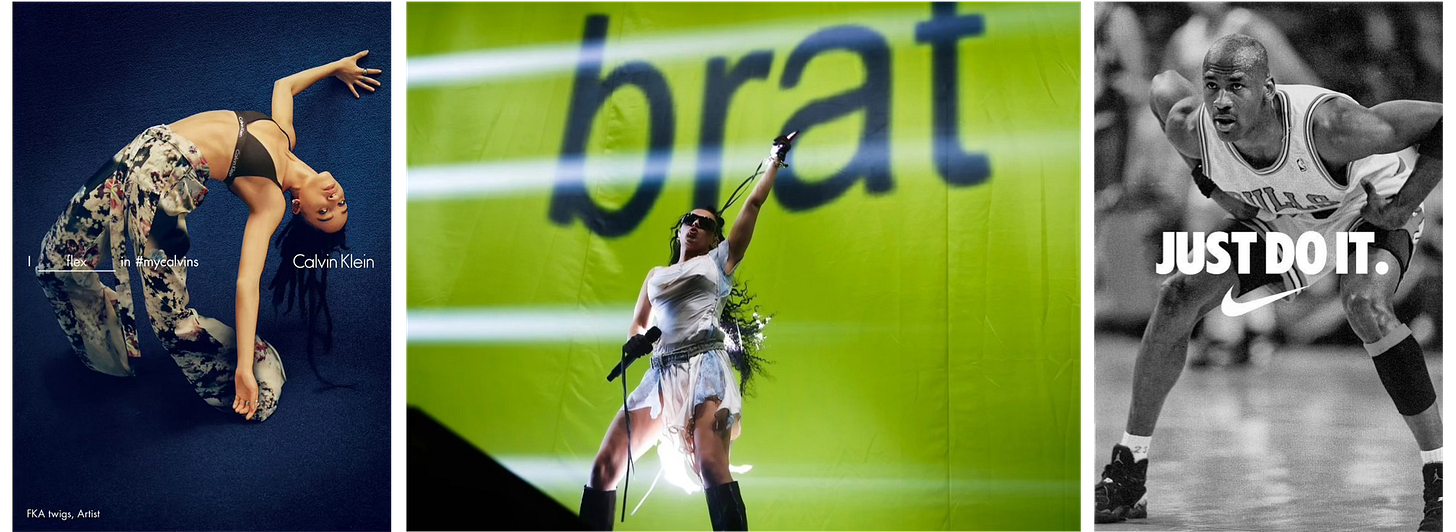
From J’Adior to #MyCalvins, luxury brands are weaponising language itself, creating words and phrases that become cultural currency, psychological triggers, and billion-dollar assets that live rent-free in our minds.
WHAT'S HAPPENING. Brands Are Hijacking Your Vocabulary
Three words changed everything for Nike. Four characters built Calvin Klein's social presence. And two words created Balmain's army.
Without us even noticing, brands stopped only selling products and started selling language itself. They're not crafting slogans anymore: they're engineering words and phrases that become rooted in our brain, turn customers into walking advertisements, and are able to communicate the brand identity of billion-dollar companies with just a few syllables (and sometimes a hashtag).
This isn't just clever marketing. It’s linguistic infiltration.
Miu Miu offers the most recent example with "Miutine," a neologism created for its latest fragrance campaign. The term - a play on the French word "mutine" (rebellious, mischievous) - was designed to embody the house's irreverent spirit. Rather than simply naming a product, Miu Miu engineered a word that could define an attitude, turning the fragrance launch into an exercise in linguistic branding.
Looking back at last summer, Charli XCX’s brat phenomenon proves that sometimes the most powerful brand language extends beyond physical products. The lime-green album spawned a one-word, high-arousal meme that came to embody a whole cultural energy and lifestyle, as phrases like "it's so brat" came to define the unapologetic attitude embodied by the artist.
Brands have been perfecting this approach for decades. L'Oréal's "Because You're Worth It" remains the gold standard of linguistic psychology: a causal structure that doesn't just justify purchase; it transforms consumption into self-care philosophy. Launched in 1971, it was revolutionary for addressing women directly with second-person singular, making each individual feel personally deserving of luxury. The "because" clause provides pre-emptive justification for indulgence, while "worth it" ensures that when you buy cosmetics, you're not just feeling like you’re making a transaction, but a statement of self-value. Nike's signature "Just Do It" slogan works similarly as a strong imperative that feels like encouragement.
Calvin Klein's "#MyCalvins" transforms possessive pronouns into psychological ownership engines, launched in 2014 with the campaign "Show yours. #mycalvins." The hashtag doesn't just encourage user-generated content: it completely changes how people think about the relationship between self and product. Suddenly, the brand isn't something you buy; it's something that belongs to you.
Courtesy of Calvin Klein, Getty Images, Nike
Balmain's Creative Director Olivier Rousteing created the "Balmain Army," transforming admirers into active participants in a movement that completely defined culture in the 2010s. By explicitly calling fans an "army," the brand creates a social structure where membership signals status and shared values
Some brands have achieved the ultimate linguistic victory: entering everyday vocabulary. Gucci illustrates this dual phenomenon perfectly: the brand became both a descriptive phrase ("it's so Gucci" meaning stylish or cool) and actively coined terms like "Guccification" during Alessandro Michele's tenure. Dior's "J'Adior" transforms the brand name into a French-inflected declaration of love, creating linguistic ownership over the sentiment itself.
These strategic successes have common traits: short enough to remember, flexible enough to remix, and sticky enough to survive algorithm churn. They're not just marketing messages - they're cultural formats that invite participation.
Why is this approach gaining momentum now? Because we've reached peak attention scarcity, and frankly, most marketing fails to stick. In today's fast-moving digital world, fragmented attention spans make short, sticky units of meaning disproportionately valuable.
But here's what not all brands understand: this isn't just about creativity. It's about human psychology. The brands winning this aren't just good at words: they're good at rewiring brains. And the mechanisms behind why we've defined an entire summer "brat" or posted "#MyCalvins" are more fascinating - and more calculated - than you might think.
WHY YOU SHOULD CARE. The Psychology of Sticky Language
Five psychological principles explain why some brand language embeds itself in culture while most disappears into the noise.
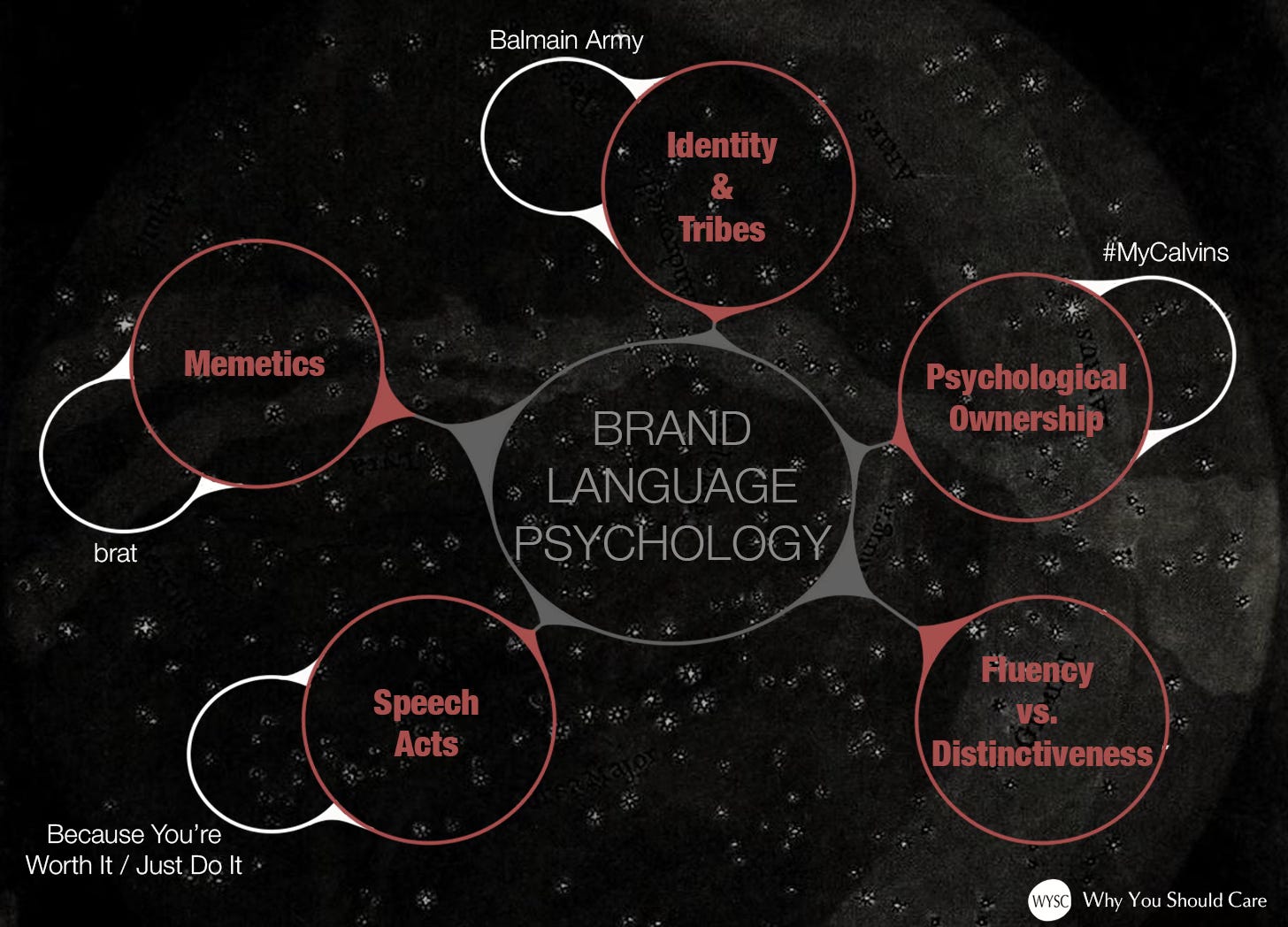
Identity & Tribes. Naming the group (Balmain Army) or the self (My Calvins) builds belonging and advocacy. Social Identity Theory reveals that people maintain positive self-esteem by identifying with high-status groups, and language that explicitly creates group membership taps into this fundamental drive. When Balmain calls its community an "army," it's creating a social structure where membership signals status and shared values. The psychological mechanism is powerful: people don't just buy the product, they join the movement.
Psychological Ownership. Here's where things get interesting. Possessives and first-person frames heighten attachment and drive content creation. Research demonstrates that merely touching an object increases perceived ownership, but linguistic possession works similarly at scale. When Calvin Klein gets users to say "#MyCalvins," they're triggering what behavioural scientists call "psychological ownership": a cognitive state where people feel something belongs to them even without legal possession. This emotional attachment translates directly into advocacy behaviour and user-generated content.
Fluency vs. Distinctiveness. This represents the core strategic trade-off in linguistic branding. Processing fluency research shows that statements which are easier to process feel more truthful and likeable. Nike's "Just Do It" achieves maximum fluency through monosyllabic simplicity, creating immediate acceptance. But distinctive coinages (the creation of new, unique words or phrases such as Miu Miu’s “Miutine”) sacrifice fluency for memorability: they're harder to process initially but create stronger memory traces. The choice depends on strategic priorities: broad appeal versus differentiated positioning.
Speech Acts. Grammar isn't neutral. Different structures drive different psychological responses. Nike's imperative ("Just Do It") creates urgency and movement, functioning as both directive and identity badge. L'Oréal's causal structure ("Because You're Worth It") provides justification that transforms consumption into self-care philosophy. Speech-act theory explains how these grammatical choices perform different actions in the reader's mind, shaping not just comprehension but behaviour.
Memetics. The most successful brand language functions like digital memes; easy to imitate, transform, and circulate. BRAT perfectly illustrates this principle: Charli XCX's album title became a cultural template that brands could adopt without needing permission or licensing. The word's memetic properties - brevity, attitude, visual distinctiveness (that lime green) - made it incredibly easy for luxury houses to co-opt and remix.
But memetic potential alone isn't enough. The key to successful language strategy lies in understanding network effects: linguistic innovations follow adoption curves that need early adopters to seed usage, then mainstream adoption to become self-sustaining cultural vocabulary. You can't just craft the phrase; you need to plan for adoption. The ultimate success is when brands transcend marketing to become actual language. Google and Photoshop became verbs (“to google”, “to photoshop”), Jacuzzi transformed from a company name to the generic term for hot tubs. When people say "it's so Gucci," they're using it as cultural shorthand for stylish authenticity - the highest form of brand language success.
Building Language Into Strategy
The most sophisticated brands treat distinctive language as infrastructure, not decoration.
Search optimisation increasingly depends on ownable linguistic territory. Brands that create distinctive language don't just own mindshare: they own discoverability, making themselves easier to find in an increasingly crowded digital landscape (and potentially decreasing customer acquisition costs).
Intellectual property strategy separates tactical campaigns from strategic assets. Forward-thinking brands trademark distinctive phrases where possible and design for multi-season reuse, building memory structures that compound over time.
The Risks and Rewards of Language Strategy
The risks are real and highly visible when things go sideways. Engineered language can feel forced, exclusionary, or culturally tone-deaf, especially in global contexts. The line between memorable and cringey is thinner than most brands realise.
Cultural sensitivity matters exponentially more in connected global markets. The brands succeeding at linguistic innovation invest heavily in cultural consultation and local market testing before rolling out distinctive language globally.
Perhaps the biggest risk is trying too hard. Authentic linguistic innovation feels inevitable, not engineered. The brands doing this best understand that great language doesn't just communicate: it invites participation, creates belonging, and gives people expressive tools they didn't know they needed.
In an attention economy where everyone's fighting to be heard, the smartest strategy might be giving people something worth saying. The right language doesn't just capture mindshare, it creates cultural territory that becomes increasingly valuable over time.
THE LIST
The Language Strategy Playbook
- START WITH PSYCHOLOGY, NOT CREATIVITY
- Deploy emotional triggers (rebellion, ownership, belonging)
- Choose grammar strategically: imperatives command, causals justify, possessives claim
- Create implicit assumptions that make users complicit in their own persuasion
- DESIGN FOR VIRALITY
- Map your adoption ecosystem: who are your linguistic early adopters?
- Create templates, not statements - language people can make their own
- Engineer network effects: seed with influencers, amplify through communities
- Plan for semantic evolution: how might your brand language naturally enter common usage (at least in certain settings)?
- PLAY THE LONG GAME
- Secure IP protection: trademark what you can, defend what matters
- Design for longevity: multi-season reuse, evolutionary potential